Showing posts with label JS. Show all posts

Wednesday, August 24, 2016

Block level scoping in JavaScript

Block level scoping in JavaScript

If you are familiar with JavaScript. If you are working as FE developer then must be aware that JavaScript has functional level scoping not block level scoping as in C family languages.

Now, from ES6 JavaScript introduces let keyword. "var" keyword is still there which will function in same manner as it is currently. Using let keyword you can declare one variable inside one block and its scope will be in that block only as block level scoping in C family languages.

For example
// using var only
function myFun(){
 var a=1;
 if(a>0){
  var b=2;
 }
 console.log(b);
}

myFun(); // 2

// using let keyword
function myFun2(){
 var a=1;
 if(a>0){
  let b=2;
 }
 console.log(b);
}

myFun2(); // Uncaught ReferenceError: b is not defined

In above example second function myFun2 gives error as let has block level scoping only and it is declared inside if block so it is not available out side if block.


Sunday, April 24, 2016

AngularJS advanced trick and techniques

These days AngularJS is highly recommended framework for front-end developer. Angular is really awesome framework to work with. Below are few techniques those I feel really cool features and may be these are simple and easy for you but as a fresher in angular I think these features are really good.

1. How to add multiple classes in ng-class?

Everyone knows how to add class using ng-class, its very easy. We can use ng-class to have more than one class as well

 
// single class
// multiple class
some content

Similarly we can add many classes separated by comma (,)

2. Can we have multiple conditions in ng-hide and ng-show?

Yes, we can have multiple conditions in ng-hide and ng-show.

// ng-show with multiple conditions
Some content

3. How to share methods or data between controllers?

Yes we can share data and methods between controllers using Factory or Service. Angular has service as constructor method which instantiate once on startup and we can use this service/factory in any controller within the module by injecting on controller method.

Restrict input to allow only required value (jQuery plugin for input type validation)

HTML5 provides many validation on input, but still few we need to implement by our self. For example, if we need one input for price then we should allow users to enter only float values. I created one small plugin using jQuery, it is very easy to use.

To create one input with only price value then just include attribute "only-price"


To create one input with only number (contact) value then just include attribute "only-number"


Here is the codepen: http://codepen.io/JitendraPal/pen/JXBqXj

Thursday, October 1, 2015

how to align elements in a row with equal space around

Hello friend,
For any front-end developer aligning elements in a row with equal space is very common problem. This problem can be solved very easily if site is non responsive. But it will little difficult if your site is responsive. One method to solve this problem is use some calculation with margin/padding to properly align elements with spaces in between. Or one solution can be write huge media query for spaces in all different window widths. For example to create menu bar and keep it align horizontally for all small devices as well.

CSS3 provides one very good feature to solve such problems easily, that is- display: flex

Consider below code to display divs with text class as headers link
 
Item1
Item2
Item3
Item4
Item5

Apply this CSS code to display headers properly in all window widths

#container{
    display:flex;
    justify-content: space-around;
}
.delimeter{
    border-left:1px solid red;
}
Result of this code will be as:
You can check this link to see the example: https://jsfiddle.net/JitendraPal/6fdLpLxd/

To work properly in all browsers use prefixed appropriately as shown below:

          display: flex;
          display: -moz-flex;
          display: -ms-flex;
          display: -webkit-flex;
          justify-content: space-around;
          -ms-justify-content: space-around;
          -webkit-justify-content: space-around;
          -moz-justify-content: space-around;

Sunday, August 30, 2015

JavaScript amazing facts

JavaScript is the most used language of this time on the planet earth.

  1. Everything is object in JavaScript, even function is also a first class object.
    • You can pass function object as an argument to a function
    • Function object can be returned from a function
    • Function may assigned to a variable
    • Function May be stored in an object or array
  2. JavaScript programs use Unicode character set (UTF-16) which is super-set of ASCII and Latin-1 and supports virtually every written language currently used on the planet
  3. NULL is an object in JavaScript
  4. NaN is a number, if we say typeof NaN, then it would be number
  5. typeof Infinity is a number
  6. Function can execute themselves. We call them self executing function. This is very important concept/feature which is used at many places
  7. using typeof we can not get if any variable is of type array. So how we can determine if a variable is of type array?
    var ar = [1,2,3];
    ar instanceof Array // this will return true because ar is of type array
    
    There is one more way to get the type of any variable:
    var ar = [1,2,3];
    Object.prototype.toString.call(ar); // "[object Array]"
    

Thursday, July 9, 2015

One good way to declare Global Variables in JavaScript

In JavaScript, declaring one variable as global is very easy, some one can say that if you just write a=3; "a" will be global, and if you write var a=3; then a is local (It is not at all true..!).

Let me explain first scope in JavaScript, JavaScript is functional level scoping language (not block level as C family languages) and any variable declared inside a function is not available to outer function (parent function).

Any variable directly declared or initialized outside (not inside any function) will be global variable

        var myVar = 3; // global variable 
        function myFun(){
            var funVar = 33; // this variable is not global, scope of this variable is within "myFun" function
        }
    
Below image explain it better on console, window is the root object in a browser, so if we declare any variable outside then it comes directly under window object:

In above snapshot window.funVar is undefined because this variable is not available globally because it is inside function "myFun".

Main aim of this post is to find out best way to keep all the global variables if required in an application. One question will come in mind that, why we should avoid global variables in an application??

Normally in an application there are many JS files and if any 2 or more files have same variable name and those are global then application will be messed up and it will really hard to find the issue sometime. So we should always avoid using global variables.

Before ECMA Script 5 strict mode, there were no way to check that inside function we have declared global variable by mistake. But now using "use strict" we can find out such issues.

We can create a class to have all the global variables inside that, and using getter nd setter method we can easily get and set the variables.

// how to use Global variables in JS
    var GlobalVariables = function () {
        // keep all the variables in this GlobalVars object
        var GlobalVars = {
            var1: 123,
            var2: 456,
            var3: "values"
        }
        this.get = function (name) {
            return GlobalVars[name];
        };
        this.set = function (name, value) {
            GlobalVars[name] = value;
        };
    };

    // craeate an object to fetch all the varibales and you can set also using get and set methods
    var global = new GlobalVariables();
Usage of above global object is as shown in console below:

Wednesday, July 1, 2015

Advanced JavaScript Questions

Hello Friend,

I am sharing few questions which are most important in JavaScript. These are advanced concepts in JavaScript. You can refer my previous posts to go through them thoroughly.

  1. Hoisting concept
  2. OOPs in JavaScript
    1. Prototypal and classical model
    2. Inheritance
    3. Polymorphism
    4. Encapsulation (modeling)
  3. Closure
  4. What is prototype
  5. What is __proto__
  6. What is new in JavaScript
  7. What is bubbling
  8. Will the methods added later in prototype available in the object which is created earlier
  9. What is constructor in function prototype
  10. Scoping in JavaScript (function level vs block level)
  11. What is this
  12. How function work as constructor
  13. In how many ways we can declare functions
  14. Can you create a function which will add n numbers (n is not fixed)
  15. Number of way we can call the functions in JavaScript
  16. What is JSONP
  17. What is CORS
  18. Does inner function get access to the outer function "this"? If not how we can use "this" object inside inner function
  19. Why we use JQuery reference from CDN
  20. Is JavaScript multi-threaded or single threaded?
  21. How setTimeOut works in JavaScript? What is setInterval?
  22. What is Event Loop in JavaScript?
  23. How to create clone of a object?
  24. How to compare 2 objects are same or not?
  25. How to Swap 2 elements of an array by using Array functions available in JavaScript
  26. What is the difference between document.ready and window.load?
  27. How to check if one variable is of type Array?
  28. How can you empty an array in JavaScript? What will happen if you use arr.length = 0 ?
  29. Explain complete rendering of a page. Suppose you hit www.google.com, explain all the process step by step.
  30. How to remove one property from an Object in JavaScript
  31. What is instanceof operator in JavaScript?
  32. What are Function, Method, and Constructor in JavaScript? How to implements these in JavaScript?
  33. What is self invoking function in JavaScript and what is the use of it?
  34. What are the design pattern in JavaScript?
  35. What is singleton pattern? How we can achieve singleton pattern in JavaScript?
  36. In how many way you can create object in JavaScript?
  37. What is Publisher Subscriber architecture in JavaScript? How we can implement this?
  38. How to flatten an object in JavaScript?
  39. How to un-flatten object in JavaScript?
  40. How to prevent object modification in JavaScript? What is the difference between seal and freeze
  41. What is strict mode ("use strict") in JavaScript?
  42. Write a function to merge 2 objects dynamically in JavaScript.

Answers for all the above questions will be posted soon...


Monday, June 22, 2015

Closures in JavaScript

Closure in JavaScript are most confusing term, but actually it is most powerful concept of JavaScript. Closure occurs in JavaScript because of functional level scoping. Function inside function can use members of outer function (parent function).

I would like to write 2 most important

  1. The context of an inner function includes the scope of the outer function.
  2. An inner function enjoy that context even after the parent functions have returned.

Let’s discuss one problem scenario, suppose we have one button on the page and now we need how many times button is clicked, we need the count. One simple way of implementation is: use one global variable and increment that variable on button click. This is easy but Global variables are not good to use, because same variable name might be present in the application. It is never recommended to use global variable in JavaScript. One good solution to this is to use functional level scoping of JavaScript and create Closure. Closure in JavaScript are caused due to function level scoping.

Below is one example of closure which is used to get one incremented number every time.

    var getCount = (function () {
        var counter = 0; // parent function variable which is accessible in child function
        return function () {
            return ++counter;
        };
    })(); // self executing function 

The output of this function when called will be as shown below:

Saturday, June 20, 2015

Private functions and variables in JavaScript..!

Private function or properties we know very well in programming language like Java, C#. Is it possible to achieve this in JavaScript? Yes..!

If you want to know more about Object oriented concepts in JavaScript then please first go through this post: OOPs in JS

In JavaScript Functions are so powerful to build OOPs and modular concepts. Following concepts are implemented using Function only in JavaScript:

  1. Method
  2. Class
  3. Constructor
  4. Module

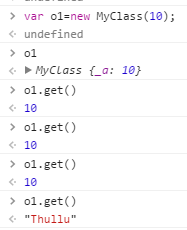
Below code shows the code which create class MyClass and it has private members:

    function MyClass(a) {
        var count = 3; // private member

        // this check function is private function
        function check() {
            if (count > 0) {
                count--;
                return true;                
            }
            else {
                return false;
            }
        }
        this._a = a;
        this.get = function () {
            if (check()) { // use of private function
                return this._a;
            }
            else {
                return "Thullu"; // after invoking get method 3 times in the object this else will be executed
            }
        }
    }

In the above code variable, count is private as any object created from MyClass will not have this variable similarly function check() is private function as this function is not part of this in the MyClass. When we create an object of MyClass using new keyword this is returned. This concept is possible in JavaScript because of lexical scoping (functional scoping).

When we create object of this class MyClass, and call the get method more than 3 times:

I would like to write few points regarding new keyword.

  1. When a function is called with the new operator, a new object is created with prototype members and assigned to this.
  2. Above statement is true only if there is no explicit return value in the function. If explicit return is present in Class (function), then same return will be assigned to the object.

I would like to give here one more example with very basic functionality like in all OOP languages we have. We declare private field and then use public properties to expose the private field, in more formal and OOPs way we create Get and Set method to update private field or retrieve private member of class.

Same get and set functionality for private variables in JavaScript we can achieve as shown in below example:

 // private class with get and set methods
    function MyClass() {
        var _privateField = 0; // It is private field as it is not part of "this"
        this.GetPrivateField = function () {
            return _privateField;
        };
        this.SetPrivateField = function (value) {
            _privateField = value;
        };
    }
Following is the console output using above MyClass object:

Sunday, June 14, 2015

JavaScript function as an Object


If you have experience in JavaScript then I am sure you have heard about functions in JS are first class object. In this post I will try my best to explain about functions in JS as an object.

There are many ways to create functions in JS, you can get to know about this in this post: Number of ways to create function

We can add property in any function as we add in any object:

    var MyObj = {}; // creating object
    MyObj.prop1 = "value1"; // Added one property
    console.log(MyObj.prop1); // logs: value1

    // creating function
    function MyFun(arg1, arg2) {
        return arg1 + arg2;
    }

    // adding property in function, and function behave as an object
    MyFun.property1 = "funPropValue1";
    console.log(MyFun.property1); // logs: funPropValue1 
Above code shows that function behave in same way as object while adding new property in function.

Pass function in another function as an argument

In below code a method is passed in function argument, and it executes successfully:
    var MyObj = {};
    MyObj.prop1 = "value1";
    MyObj.logValue = function (value) {
        console.log(value);
    }

    function MyFun(arg1, argFun) {
        var myVal = 1;
        myVal++;
        argFun(myVal);
    }

    MyFun(12, MyObj.logValue); // logs: 2
As we can perform operations similar to object in functions we can say that functions are first class object in JavaScript.

Saturday, June 13, 2015

Number of ways in JavaScript to create functions

Functions in JavaScript are first class object, we can add properties in functions as we add in any object of JavaScript. We can pass function as argument in any function as we pass any object or variable. There are 3 ways we can define function in JavaScript.

  1. Function constructor
  2. Function statement
  3. Function expression

1. Function constructor

Create function using Function constructor as shown below, I am creating one simple function for addition of 2 numbers:
var add= new Function('x','y','return (x+y);');
In this type of function creation, last parameter is the function body. we can pass as many parameters we want. In below example I am passing 3 parameters.
var add= new Function('x','y','z','return (x+y+z);');

2. Function statement

This is the very common or we can say general approach to create function in JavaScript and similar to other programming languages.
function add(a,b){
 return (a+b);
}
This approach is very simple and easy to understand for new developer of JavaScript also.

3. Function expression

In this approach function is declared in a variable, it is like one expression in JavaScript.
var add = function(a,b){
 return (a+b);
};
There is one more variation of this approach which is called named function expression. As you noticed in above function there is no name given after function keyword, but can give name also as shown below:
var add= function addFn(a,b){
 return (a+b);
};
We can give any name after function and both codes (expression and named expression) behavior is same.

Sunday, June 7, 2015

AJAX call in AngularJS for cross domain service using JSONP

It is very easy to set up AJAX call in AngularJS with $http.get(). Similarly in Angular cross domain request is also very easy using JSONP, below code shows how to set up AJAX call for cross domain using $http.jsonp():

(function () {
    var App = angular.module("AngularCrossDomain", []);
    App.controller("AppController", function ($scope, $http) {
        $http.jsonp('<Your Service URL>?callback=JSON_CALLBACK')
            .success(function (data) {
                console.log("pass");
                $scope.value = data; 
            })
            .error(function (data) {
                console.log("failed");
            });
    });
})();

Sunday, May 24, 2015

To Do list App with Angular JS (Learn basic concepts of Angular JS)


Hello All,

Angular JS is really awesome framework created by Google, I learn just basic concepts of Angular JS from codeschool and able to create this application. This small application is a To Do list to keep track of your tasks. I created this for only running session, there is no permanent storage of tasks information.

The HTML code used for Tasks App:
Total Tasks: {{TaskCtrl.taskCounter}} Tasks Pending: {{TaskCtrl.taskPendingCounter}} Tasks Done: {{TaskCtrl.taskDoneCounter}}


Add Task

In Angular JS we can have any number of template file which can be included any where in HTML code using "ng-include" directive of Angular JS, Template file for task "TaskTemplate.html" is as shown below:

{{task.title}}: {{task.description}}
Done?

JavaScript file to create controller for Tasks App is as shown below:

(function () {
    var TaskApp = angular.module("TaskApp", []);
    var Tasks = {
        TasksDetail: [
            {
                id: 1,
                title: "Sample Task 1",
                description: "GO for Aadhar card on Saturday",
                isDone: true
            },
            {
                id: 2,
                title: "Sample Tasks 2",
                description: "Go to shopping in InOrbit on Sunday to buy jeans",
                isDone: false
            }
        ],
        TaskStarted: "Today"
    };

    TaskApp.controller("TaskController", function () {
        this.tasks = Tasks.TasksDetail;
        this.addTask = function (taskTitle, taskDetail) {
            if (!!taskTitle) {
                var task = {
                    id: this.tasks.length + 1,
                    title: taskTitle,
                    description: taskDetail,
                    isDone:false
                }
                this.tasks.push(task);
                this.updateCounter();
                this.taskTitle = "";
                this.taskDesc = "";
            } else {
                alert("Enter title");
            }
        };
        this.removeTask = function (taskId) {
            if (confirm("Task will be deleted..!")) {
                this.tasks.splice(this.getTasksIndex(taskId), 1);
                this.updateCounter();
            }
        };
        this.doneTask = function (taskId,bFlag) {
            this.tasks[this.getTasksIndex(taskId)].isDone = bFlag;
            this.updateCounter();
        };

        this.getTasksIndex = function (taskId) {
            var index = 0;
            for (index = 0; index < this.tasks.length; index++) {
                if (this.tasks[index].id == taskId) {
                    return index;
                }
            }
            return -1;
        };
        this.getTasksCounter = function (isDoneFlag) {
            var counter = 0, index = 0;
            for (index = 0; index < this.tasks.length; index++) {
                if (this.tasks[index].isDone === isDoneFlag) {
                    counter++;
                }
            }
            return counter;
        };
        this.updateCounter = function () {
            this.taskPendingCounter = this.getTasksCounter(false);
            this.taskDoneCounter = this.getTasksCounter(true);
            this.taskCounter = Tasks.TasksDetail.length;
        };
        this.updateCounter();
    });
})();

You can use the app which I have hosted here, you can try to add new tasks, try to complete the taks and delete the tasks:

Style on app is from customized CSS file, you can update CSS properties to update UI/UX. My CSS file is as shown below:

body {
    background-color: #1ec885;
    font-family: 'Lucida Sans', 'Lucida Sans Regular', 'Lucida Grande', 'Lucida Sans Unicode', Geneva, Verdana, sans-serif;
    color: white;
}

#TaskForm {
    color: white;
}

.Box {
    width: 150px;
    height: 20px;
    display: inline-block;
    margin-top: 5px;
}

.InputTextBox {
    width: 100%;
    border-radius: 4px;
}

.InputTextBoxDescription {
    height: 35px;
}

.Button {
    text-align: center;
    cursor: pointer;
}

.ImageButton {
    vertical-align: middle;
}

.AddButton {
    background-color: #ff6a00;
    width: 200px;
    height: 30px;
    padding-top: 10px;
}

.RemoveButton {
    background-color: #961616;
    width: 20px;
    display: inline-block;
    height: 17px;
}

.DoneButton {
    background-color: #ff6a00;
    width: 50px;
}

#TaskFormTable {
    width: 100%;
}

.TaskItem {
    margin: 5px;
}

.TaskTitle {
    font-weight: 900;
}

Tuesday, March 3, 2015

Object Oriented Programming in JavaScript (Class in JavaScript)


Hello All, I would like to explain OOPs concept here which are very useful while using JavaScript for a large project. Object oriented concept in JavaScript is very useful in case you are creating modules in your project. Before starting I would like to cover few basic things about JavaScript. Class in JavaScript is nothing but function. There are 2 ways to create object of a class in JavaScript:
  • Using Object.create (Prototypal Model)
  • Using new keyword (Classical Model)

Using Object.create (Prototypal Model)

var TilePrototype = {
   constructor: function(header,value) {
      this._header = header;
      this._value = value;
   },
   render: function(){
      // Your code here to create tile using header and value;
   }
}

var myTile = Object.create(TilePrototype); // Here you created object of TilePrototype
myTile.constructor("My first tile", "Some value"); // Initialize the value using constructor
myTile.render(); // Call render method to create tile

Now how to achieve inheritance using Object.create

   var AdvancedTilePrototype = Object.create(TilePrototype);
   AdvancedTilePrototype.render = function(){
      TilePrototype.render.call(this);
      // add some more advanced functionality here which will be extended including parent class method. 
   }
  // Now any one can create object of this child class
  var myAdvancedTile = Object.create(AdvancedTilePrototype);
  myAdvancedTile.constructor("My advanced tile","value");
  myAdvancedTile.render();

Using new keyword (Classical Model)

  function Tile(header,value){
    this._header = header;
    this._value = value;
  }
  Tile.prototype.render = function(){
    // Your code here to create tile using header and value;
  }
  var myTile = new Tile("My first tile", "some value"); // create new object of Class Tile
  myTile.render(); // Call render method to render tile

Now how to achieve inheritance in this classical model

  function AdvancedTile(header, value){
    Tile.call(this, header, value);
  }
  AdvancedTile.prototype = Object.create(Tile.prototype);
  AdvancedTile.prototype.constructor = AdvancedTile;
  AdvancedTile.prototype.render = function(){
    Tile.prototype.render.call(this);
    // add your advanced code
  }

Wednesday, June 4, 2014

Cross Site Scripting in WCF Web Service. How to use AJAX in JavaScript to Get/Consume JSON from WCF in C#


WCF (Windows Communication Foundation) is a latest service oriented architecture. You can expose methods in WCF depend on the requirement. For example if we want to expose method which will return JSON data. then we need to mention this type of contract in method declaration. In this article I am focusing on exposing method which return string (JSON) and how a client can call this method from JavaScript (AJAX call using jQuery)

To expose a method in WCF as JSON we need to provide valid Contract:

[OperationContract]
[WebInvoke(Method = "GET", RequestFormat = WebMessageFormat.Json, ResponseFormat = WebMessageFormat.Json, BodyStyle = WebMessageBodyStyle.WrappedRequest)]
string GetJSONData(string param1);

Above method accept one parameter "param1". WCF will expose this method to out side world and it can be used in AJAX call. This method can be consumed directly using query string also. If service url is:
https://MyServiceURL/Service.svc/json/
then we can call this method as:
https://MyServiceURL/Service.svc/json/GetJSONData?param1=123

AJAX call can also be setup easily with dataType as JSONP in case you are seeting up in cross domain. Jsonp is json with padding specially for cross domain request, if you are hosting a client application in different domain compare to service then you need to use datatype as JSONP in ajax request.

var ajaxRequest = $.ajax({
        type: "GET",
        url: https://MyServiceURL/Service.svc/json/GetJSONData?callback?",
        contentType: "application/json; charset=utf-8",
        dataType: "jsonp",
        data: { param1: "123" },
        success: function (oJSONObject) {
    // Your code here
 }