Monday, June 22, 2015

Closures in JavaScript

Closure in JavaScript are most confusing term, but actually it is most powerful concept of JavaScript. Closure occurs in JavaScript because of functional level scoping. Function inside function can use members of outer function (parent function).

I would like to write 2 most important

  1. The context of an inner function includes the scope of the outer function.
  2. An inner function enjoy that context even after the parent functions have returned.

Let’s discuss one problem scenario, suppose we have one button on the page and now we need how many times button is clicked, we need the count. One simple way of implementation is: use one global variable and increment that variable on button click. This is easy but Global variables are not good to use, because same variable name might be present in the application. It is never recommended to use global variable in JavaScript. One good solution to this is to use functional level scoping of JavaScript and create Closure. Closure in JavaScript are caused due to function level scoping.

Below is one example of closure which is used to get one incremented number every time.

    var getCount = (function () {
        var counter = 0; // parent function variable which is accessible in child function
        return function () {
            return ++counter;
        };
    })(); // self executing function 

The output of this function when called will be as shown below:

Saturday, June 20, 2015

Private functions and variables in JavaScript..!

Private function or properties we know very well in programming language like Java, C#. Is it possible to achieve this in JavaScript? Yes..!

If you want to know more about Object oriented concepts in JavaScript then please first go through this post: OOPs in JS

In JavaScript Functions are so powerful to build OOPs and modular concepts. Following concepts are implemented using Function only in JavaScript:

  1. Method
  2. Class
  3. Constructor
  4. Module

Below code shows the code which create class MyClass and it has private members:

    function MyClass(a) {
        var count = 3; // private member

        // this check function is private function
        function check() {
            if (count > 0) {
                count--;
                return true;                
            }
            else {
                return false;
            }
        }
        this._a = a;
        this.get = function () {
            if (check()) { // use of private function
                return this._a;
            }
            else {
                return "Thullu"; // after invoking get method 3 times in the object this else will be executed
            }
        }
    }

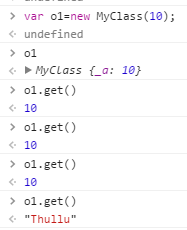
In the above code variable, count is private as any object created from MyClass will not have this variable similarly function check() is private function as this function is not part of this in the MyClass. When we create an object of MyClass using new keyword this is returned. This concept is possible in JavaScript because of lexical scoping (functional scoping).

When we create object of this class MyClass, and call the get method more than 3 times:

I would like to write few points regarding new keyword.

  1. When a function is called with the new operator, a new object is created with prototype members and assigned to this.
  2. Above statement is true only if there is no explicit return value in the function. If explicit return is present in Class (function), then same return will be assigned to the object.

I would like to give here one more example with very basic functionality like in all OOP languages we have. We declare private field and then use public properties to expose the private field, in more formal and OOPs way we create Get and Set method to update private field or retrieve private member of class.

Same get and set functionality for private variables in JavaScript we can achieve as shown in below example:

 // private class with get and set methods
    function MyClass() {
        var _privateField = 0; // It is private field as it is not part of "this"
        this.GetPrivateField = function () {
            return _privateField;
        };
        this.SetPrivateField = function (value) {
            _privateField = value;
        };
    }
Following is the console output using above MyClass object:

Sunday, June 14, 2015

JavaScript function as an Object


If you have experience in JavaScript then I am sure you have heard about functions in JS are first class object. In this post I will try my best to explain about functions in JS as an object.

There are many ways to create functions in JS, you can get to know about this in this post: Number of ways to create function

We can add property in any function as we add in any object:

    var MyObj = {}; // creating object
    MyObj.prop1 = "value1"; // Added one property
    console.log(MyObj.prop1); // logs: value1

    // creating function
    function MyFun(arg1, arg2) {
        return arg1 + arg2;
    }

    // adding property in function, and function behave as an object
    MyFun.property1 = "funPropValue1";
    console.log(MyFun.property1); // logs: funPropValue1 
Above code shows that function behave in same way as object while adding new property in function.

Pass function in another function as an argument

In below code a method is passed in function argument, and it executes successfully:
    var MyObj = {};
    MyObj.prop1 = "value1";
    MyObj.logValue = function (value) {
        console.log(value);
    }

    function MyFun(arg1, argFun) {
        var myVal = 1;
        myVal++;
        argFun(myVal);
    }

    MyFun(12, MyObj.logValue); // logs: 2
As we can perform operations similar to object in functions we can say that functions are first class object in JavaScript.